
How to Store Coffee Beans Properly: Keep Them Fresh
Table of Contents
- The 4 Enemies of Fresh Coffee Beans (and How to Beat Them)
- Why the Original Bag Is Often Your Best Storage Container
- How Long Do Coffee Beans Stay Fresh? A Timeline
- Choosing the Best Coffee Storage Containers
- Does Freezing Coffee Beans Ruin Them? The Facts
- Step-by-Step: How to Store Coffee Beans Properly
- How to Tell If Your Stored Beans Have Gone Stale
- Conclusion: Fresh Beans Start With Smart Storage
- Frequently Asked Questions
Last Updated: September 8, 2026
The 4 Enemies of Fresh Coffee Beans (and How to Beat Them)
Every coffee bean faces the same four adversaries the moment it leaves the roaster: oxygen, light, heat, and moisture. Oxidation is the primary culprit behind stale flavor, as oxygen triggers chemical reactions that break down the delicate coffee oils responsible for aroma and taste (PubMed). Light exposure accelerates this degradation, while temperature fluctuations cause condensation that ruins the bean's structure.
The specialty coffee industry widely agrees that whole bean coffee retains its peak flavor far longer than ground coffee, since grinding increases surface area and speeds up oxidation. At Redemptive Coffee, we roast in small batches and ship immediately because we know freshness is a countdown that starts at the roaster, not at your kitchen counter.
The practical fix is straightforward: store coffee beans in an opaque, airtight container kept at room temperature, away from direct sunlight and heat sources like your stove or dishwasher.
Why the Original Bag Is Often Your Best Storage Container
That foil bag your coffee arrived in is not just packaging, it is an engineered storage system. Most specialty roasters use bags with a one-way valve, also called a degassing valve, which allows carbon dioxide to escape after roasting without letting oxygen in.
Coffee beans release significant amounts of carbon dioxide for days after roasting. If that gas cannot escape, the bag will balloon or burst. The one-way valve solves this problem while maintaining an airtight seal against outside air.
The original bag only fails you once it is opened, because the zip-top seal rarely remains fully airtight after repeated use. If you finish a bag within two to three weeks of the roast date, keep the beans in the original bag and press out excess air before sealing. For longer storage, transfer the beans to a dedicated container.
How Long Do Coffee Beans Stay Fresh? A Timeline
A common question is how long do coffee beans stay fresh, and the honest answer depends on storage conditions and whether you bought whole beans or pre-ground. Whole beans stored properly at room temperature maintain their peak flavor for roughly two to four weeks after the roast date (peer-reviewed research).
Here is a practical freshness timeline based on how coffee is stored:
| Storage Method | Peak Flavor Window | Acceptable Use Window | Notes |
|---|---|---|---|
| Whole beans, original bag with valve | 2-3 weeks from roast date | Up to 6 weeks | Press out air after each use |
| Whole beans, airtight opaque container | 3-4 weeks from roast date | Up to 2 months | Best room-temperature option |
| Whole beans, freezer (long-term) | 1-2 months | Up to 6 months | Only for bulk storage |
| Ground coffee, any method | 1 week | Up to 3 weeks | Grind fresh whenever possible |
Ground coffee loses its volatile aroma compounds within days, not weeks (PubMed). The larger surface area means oxidation happens rapidly, which is why grinding immediately before brewing makes a measurable difference in your cup.
Choosing the Best Coffee Storage Containers
The best coffee storage containers block light, seal tightly, and do not impart flavors of their own. Look for three qualities: an opaque body, a gasket-lined lid, and a size that matches your consumption rate. An oversized container means more air inside every time you open it, accelerating staleness.
When selecting a container, consider how quickly you use coffee. A household brewing one pot daily needs a different container size than someone who brews occasionally. Matching container volume to your weekly usage minimizes air exposure with every open and close.
Airtight vs. Vacuum-Sealed: What's the Difference?
An airtight container simply prevents outside air from entering when sealed. A vacuum-sealed container actively removes air from inside, creating negative pressure that halts oxidation almost entirely.
Vacuum-sealed systems are excellent for long-term storage but unnecessary for daily use. Every time you open a vacuum container, you must re-pump it, which adds friction to your morning routine. A quality airtight canister with a silicone gasket provides sufficient protection for beans consumed within a month.
Glass, Ceramic, or Steel: Container Material Science
Container material matters more than most guides acknowledge. Glass is non-porous and easy to clean, but it transmits light, so it must be opaque or stored in a dark cabinet. Ceramic offers natural light blocking and stable temperatures, though the lid seal quality varies widely between brands.
Stainless steel is the strongest choice for blocking light and resisting temperature fluctuations, but cheaper models can develop off-flavors if the interior lining degrades. Whichever material you choose, never use a clear glass jar on your countertop, light exposure degrades coffee oils quickly.
Does Freezing Coffee Beans Ruin Them? The Facts
The freezer debate is not a simple yes or no, it depends on your roast level, your freezer's humidity, and how you handle the beans before and after freezing. Here is the nuanced breakdown that most guides skip.
Roast level changes the rules. Light roasts are denser and less porous than dark roasts, which means they absorb moisture more slowly. Dark roasts, by contrast, have a more expanded cellular structure and surface oils that act like a sponge for humidity. If you freeze a dark roast without a proper seal, it will pick up off-flavors and freezer odors faster than a light roast. Conversely, light roasts are more susceptible to staling from oxygen because they retain more of the chlorogenic acids that oxidize readily. So: freezing is safer for light roasts in terms of moisture, but dark roasts freeze better if the seal is perfect.
The humidity factor in your freezer. Most home freezers cycle between defrost and deep-freeze modes, causing relative humidity to swing from near 0% to over 60%. This cycling is what causes freezer burn, not just cold air. A vacuum-sealed bag eliminates this risk entirely because no air (and therefore no moisture) is present. If you do not have a vacuum sealer, use a double-bag method: place the beans in a high-barrier mylar bag with a one-way valve, press out all air, then place that bag inside a second zip-top freezer bag. The second bag is your insurance against humidity swings.
The thawing protocol matters more than the freezing. The single biggest mistake is opening the bag while it is still cold. Warm, humid kitchen air hits the frozen beans and immediately condenses, depositing a microscopic layer of water on every bean. That water accelerates the breakdown of the bean's cellular structure and leaches soluble flavor compounds. The correct method: remove the sealed bag from the freezer and let it sit at room temperature for 30 to 60 minutes, until it reaches ambient temperature, before opening. This allows condensation to form on the outside of the bag, not on the beans.
Portioning is non-negotiable. Never refreeze beans. Each freeze-thaw cycle causes cellular damage and moisture migration. Portion your bulk beans into single-week (or single-brew) amounts before freezing. A common pattern among home enthusiasts is to freeze 8-ounce portions in small vacuum bags, which gives them a week of coffee per bag without repeated exposure.
The practical verdict: Freezing is a legitimate strategy for bulk buyers, but it is not a set-and-forget solution. Light roasts freeze well with a simple airtight bag; dark roasts require vacuum sealing to avoid moisture pickup. If you drink coffee daily and buy in 12-ounce bags, skip the freezer, your beans will not last long enough to benefit.
Step-by-Step: How to Store Coffee Beans Properly
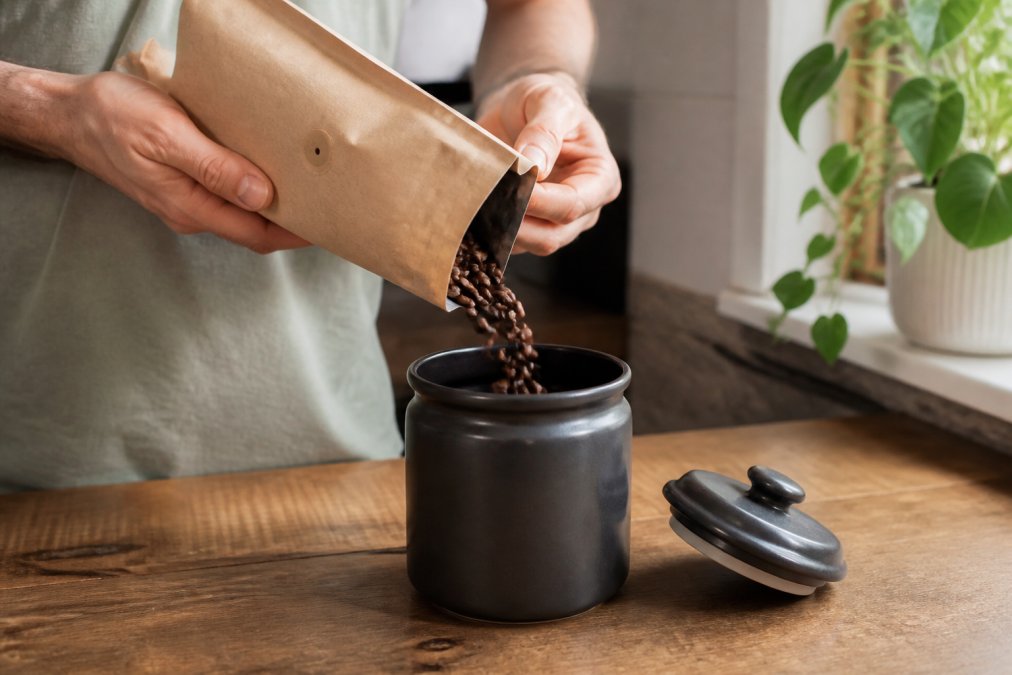
Learning how to store coffee beans properly comes down to a repeatable routine that protects freshness from roast date to brew. Follow this workflow to extend the life of every bag you buy.
- Check the roast date first. Buy coffee with a visible roast date, not just a best-by date. Freshness begins at roasting, not packaging.
- Transfer whole beans to an airtight, opaque container. Do this immediately if you plan to keep the bag for more than two weeks.
- Store at room temperature in a dark, dry cabinet. Keep the container away from the stove, dishwasher, and windows.
- Grind only what you need, right before brewing. Whole beans stay fresh dramatically longer than ground coffee.
- Buy in small batches. Purchase two to three weeks of coffee at a time so beans never sit long enough to go stale.
- Use the freezer only for bulk storage. Portion beans into sealed bags and thaw in the bag to prevent condensation.
How to Tell If Your Stored Beans Have Gone Stale
Stale coffee beans lose their aromatic complexity and take on a flat, cardboard-like flavor. The first sign is aroma: fresh beans release a strong, sweet fragrance when the container opens, while stale beans smell muted or slightly musty.
Visual cues also reveal staleness. Fresh whole beans have a matte, oily surface that develops a sheen as they age. Beans that look dry, dull, or excessively shiny have likely lost their structural integrity. When you grind stale beans, they produce more fine dust and less uniform particles than fresh beans.
The definitive test is the pour-over. Brew a small cup and taste it black. Stale coffee tastes hollow, with muted acidity and a papery aftertaste. If your stored beans fail this test, they will not recover, no storage method resurrects lost flavor.
Conclusion: Fresh Beans Start With Smart Storage
Proper storage protects the work of everyone in the supply chain, from the farmer who grew the beans to the roaster who developed their flavor. The principles are simple: block light, limit air, control temperature, and buy what you will actually use.
At Redemptive Coffee, we roast every order to your door, which means your beans arrive at peak freshness and stay there longer when stored correctly. Our small-batch approach and direct-trade partnerships ensure quality from cherry to cup, supporting farmers and community work with every purchase.
Frequently Asked Questions
What is the best way to store coffee beans for long-term use?
For long-term storage, divide your beans into small, airtight, opaque containers and keep them in a cool, dark pantry. Only open one container at a time to avoid exposing the rest to air and moisture. If you need to store beans for more than a month, freezing a portion in an airtight, vacuum-sealed bag is your best bet, but remember to let the bag come to room temperature before opening to prevent condensation.
Is it okay to store coffee beans in a Ziploc bag?
A standard Ziploc bag is not ideal for storing coffee beans for more than a few days. These bags are not truly airtight and will allow oxygen to seep in, accelerating staleness. They also do not protect beans from light. If you must use one, squeeze out as much air as possible and store the bag inside a dark pantry. For proper freshness, transfer your beans to an airtight container with a one-way valve.
Does freezing coffee beans ruin them?
Freezing coffee beans does not ruin them if done correctly. The real danger is moisture from condensation, which occurs when you open the frozen bag in a humid environment. To freeze safely, portion beans into small, airtight, vacuum-sealed bags. Remove only the portion you need, and let the sealed bag thaw to room temperature for about 30 minutes before opening it. This prevents moisture from forming on the beans, which would degrade flavor.
Is it better to store coffee beans in glass or stainless steel?
Both glass and stainless steel can work well, but stainless steel has a slight edge. While glass is non-porous and easy to clean, it is often transparent, which exposes beans to light. A stainless steel canister is opaque, blocking light completely, and is also more durable. If you choose glass, ensure it is dark or amber-colored to protect the beans from light exposure. Whichever you pick, an airtight seal is the most critical feature.